
Chapter 4
Linking Root System Architecture to Water and Nutrient Use Efficiency in Agricultural Systems: Mechanisms, Phenotyping Approaches, Quantitative Evidence, and Breeding Perspectives
- Darshan S (AC and RI Coimbatore, TNAU Coimbatore, India)
- Akilesh S (AC and RI Coimbatore, TNAU Coimbatore, India)
- ISBN
- 978-93-340-5069-1
- Published
- 10 July 2026
- Accesses
- 134 views · 35 downloads
- Reading time
- ~31 min
Abstract
Root system architecture (RSA) is a three-dimensional spatial configuration of the hidden half of the plant. It is the principal determinant of the resource uptake of a crop and thus directly influences water use efficiency (WUE) and nutrient use efficiency (NUE) of crops. Global agriculture is facing constant pressure from factors like rapidly rising populations, highly unpredictable climatic changes, and the need for sustainable use of resources. Optimizing RSA traits is a highly reliable pathway to overcome these challenges. This review critically synthesizes mechanistic, experimental, and quantitative genetic evidence linking key RSA traits which include root depth, axial root angle, root length density, lateral root branching, root hair morphology, and root cortical anatomy to WUE and NUE across major crop species including wheat, rice, maize, soybean, chickpea, and sorghum. Root phenotyping technologies are evaluated for resolution and field applicability. Artificial intelligence-based image analysis platforms are assessed using published performance benchmarks. Major genes and QTLs controlling RSA are catalogued with phenotypic effect sizes based on the results obtained by several research conclusions. Persistent knowledge gaps including limitations over subsoil phenotyping, deficits in field validation, and genotype-environment interactions are identified, and priority research directions for translating mechanistic insights into variety improvement are proposed. Studying the RSA of the crops ensures a better sustainable approach to agricultural production and management strategies. Keywords: Root System Architecture; Water Use Efficiency; Nutrient Use Efficiency; Root Phenotyping; Root Genetics
Keywords: Root System Architecture, Water Use Efficiency, Nutrient Use Efficiency, Root Phenotyping, Root Genetics
Full text
1.INTRODUCTION
The rising global population along with the escalating threats of climate, induces drought and nutrient depletion in soil. This has necessitated a shift toward enhancing the resource-use efficiency of staple crops. Lynch (2007) argued that RSA improvement constitutes a "second green revolution" opportunity. Bishopp and Lynch (2015) subsequently characterized the root systems as a "hidden half" of crop yield potential, noting that the genetic variation available for RSA improvement has been systematically underexploited relative to shoot traits.
The past two decades have produced a substantial literature on the RSA traits most relevant to water and nutrient acquisition, from research groups focused on phosphorus capture in bean and maize (Lynch and Brown, 2001; Zhu and Lynch, 2004), nitrogen capture in maize (Lynch, 2013; York et al., 2015), and drought adaptation in rice and wheat (Uga et al., 2013; Wasson et al., 2012). Simultaneously, phenotyping and genomic tools from field-deployable shovelomics to X-ray computed tomography, deep learning–based image analysis, genome-wide association studies, and CRISPR gene editing, have expanded the potential to translate mechanistic understanding into targeted crop improvement.
This review critically synthesizes current evidence on mechanistic links between RSA traits and WUE and NUE, evaluates phenotyping and genetic tools, and identifies knowledge gaps and priorities for advancing root science toward practical agricultural application. We focus on six major crop species where evidence is most substantial and where the projected magnitude of improvement justifies intensive research investment.
2. ROOT SYSTEM ARCHITECTURE: CONCEPTS AND FUNCTIONAL TRAITS
Lynch (1995) provided a foundational conceptual framework for RSA research, distinguishing root architecture (spatial configuration of root networks), root morphology (surface features of individual roots), and root anatomy (internal cellular organization), and argued that each level of organization has distinct functional consequences for soil resource uptake. These levels are functionally interdependent: architecture determines where roots are deployed in the soil profile, morphology determines uptake capacity per unit of root length, and anatomy influences the metabolic cost of root construction and maintenance (York et al., 2013).
2.1 Root Depth Distribution
Root depth distribution (RDD) is defined as the vertical and spatial arrangement of root length density, root biomass, or root number across soil profile depths. It describes how roots are quantitatively partitioned throughout the soil column from the surface to the maximum rooting depth (Harguindeguy et al., 2013).
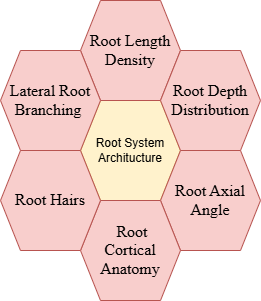 2.2 Root Axial Angle
Root axial angle (RAA) is defined as the angle formed between the vertical axis and the longitudinal axis of a root axis measured at or near the root tip, which determines the trajectory of root growth through the soil profile. It governs the spatial exploration of soil volume (Chen et al., 2018).
2.3 Root Length Density
Root length density (RLD) is defined as the total length of roots per unit volume of soil (cm root cm⁻³ soil), representing the most widely adopted quantitative descriptor of root system distribution and intensity within a given soil layer or volume. It serves as a primary functional index of the potential soil resource capture capacity of a root system. (Wacker et al., 2024)
Figure 1:Functional traits of RSA
2.4 Lateral Root Branching
Lateral root branching is defined as the developmental process by which founder cells within the pericycle of a primary or seminal root axis are specified, activated, and undergo coordinated cell divisions to initiate, and emerge as new secondary root axes (lateral roots). This helps in increasing the total root system complexity, surface area, and soil exploration capacity (Jan et al., 2024).
2.5 Root Hairs
Root hairs are defined as tubular, tip-growing epidermal extensions (trichoblasts) that emerge from the rhizodermal cell layer of the root elongation–differentiation zone. It increases the absorptive surface area of the root system without incurring substantial carbon construction costs. It plays a critical role in the acquisition of poorly mobile nutrients, particularly phosphorus, by extending the depletion zone beyond the root surface cylinder and facilitating intimate contact with soil particles and the rhizosphere microbial community (York et al., 2013).
2.6 Root Cortical Anatomy
Root cortical anatomy refers to the structural organization, cellular composition, tissue proportions, and metabolic properties of the root cortex. The parenchymatous tissue layer situated between the epidermis and endodermis encompasses traits such as cortical cell file number, cortical cell size, the formation of aerenchyma (gas-filled lysigenous cavities), and the overall metabolic cost of cortical tissue construction and maintenance (York et al., 2013).
3. Relationships Between RSA and Water Use Efficiency:
Water use efficiency can be defined at multiple scales like instantaneous transpiration efficiency (A/E), whole-crop WUE (biomass per unit of water consumed), or agronomic WUE (yield per unit of water applied). RSA influences WUE primarily through its effects on the accessibility and temporal dynamics of soil water extraction.
3.1 Root Depth and Subsoil Water Capture
The mechanistic basis for the positive relationship between root depth and WUE under drought lies in the vertical distribution of plant-available soil water. In many dryland systems, subsoil water reserves are the primary supply during grain filling when surface soils are depleted. Manschadi et al. (2006) compared the root architecture of deep-rooting Syrian wheat landrace SYR5 with the commercial Australian cultivar Hartog under field and rhizotron conditions.
In rice, Uga et al. (2013) demonstrated that DRO1 NILs of IR64 showed significantly greater root length density in the 30–60 cm soil layer and maintained higher relative water content in flag leaves during reproductive drought stress in field experiments in the Philippines. The near-isogenic approach used in this study provides strong causal evidence that root angle, rather than correlated traits, is responsible for the observed water status and yield differences. This is a methodological strength absent from many observational studies.
3.2 Crown Root Number and WUE
Saengwilai et al. (2014) demonstrated in maize that genotypes with fewer nodal crown roots maintained greater root elongation and higher relative water content under water deficit. The mechanistic basis proposed by these authors is that crown roots represent a large metabolic sink, and their reduction releases assimilate for elongation of the remaining roots into deeper, moister soil layers. This result challenges the intuitive assumption that more roots improve drought tolerance and illustrates the importance of integrating root architecture with root carbon economy.
3.3 Root Cortical Aerenchyma (RCA) and Drought Tolerance
Zhu et al. (2010) demonstrated in maize that genotypes with constitutively formed RCA maintained greater root length in deep soil layers under water deficit conditions, with higher leaf water potential and improved drought tolerance. The proposed mechanism is that aerenchyma reduces the metabolic cost per unit root length, enabling greater soil exploration depth for a given photosynthate budget. This enables a carbon economy argument analogous to that for N and P acquisition. This work established RCA as a relevant drought tolerance mechanism, extending its recognized role from flooded soil adaptation (where oxygen supply to roots is limiting) to water-limited conditions.
3.4 Hydraulic Architecture
The rate of water uptake from a given soil volume depends not only on RLD but also on root axial hydraulic conductance (determining transport capacity from uptake site to shoot) and radial hydraulic conductance of root tissues (Steudle and Peterson, 1998). As soil dries, the hydraulic conductance at the root–soil interface decreases dramatically due to increased soil water tension and reduced contact between root and soil water, and increasing RLD has diminished returns in very dry soils. Lobet et al. (2014) applied a mechanistic model of plant water uptake in drying soils and showed that root distribution relative to the wetting front, rather than total RLD, was the primary determinant of simulated water uptake under intermittent drought. This is a finding with implications for the optimal architectural strategy under variable rainfall regimes.
Table 1.
Selected experimental studies linking RSA traits to water use efficiency outcomes in major crops.
| Trait | Crop | Measured Outcome | Experimental Conditions | Citation |
|---|---|---|---|---|
| Narrow root angle distribution | Wheat | Greater RLD below 90 cm; estimated 20–30 mm additional subsoil water capture | Field + rhizotron; SYR5 vs Hartog | Manschadi et al. (2006) |
| Root cortical aerenchyma | Maize | Greater root length in deep layers; higher leaf water potential under drought | Greenhouse and field water deficit | Zhu et al. (2010) |
| Steep crown root angle | Maize | Proposed deep N and water access through SCD ideotype analysis | Theoretical + empirical root angle data synthesis | Lynch (2013) |
| Low crown root number | Maize | Improved relative water content and yield under drought | Field and greenhouse water deficit | Saengwilai et al. (2014) |
| Reduced cortical cell file number | Maize | Maintained root elongation under deficit; lower metabolic cost | Growth chamber; contrasting genotypes | Chimungu et al. (2014) |
4. RSA and Nutrient Use Efficiency
4.1 Phosphorus effect on RSA:
Phosphorus immobility in soil drives roots toward shallow, topsoil-foraging architectures with increased root hair length and lateral root density to maximize P acquisition. For example, in common bean (Phaseolus vulgaris), shallow basal root angles concentrate root length in the P-rich 0–10 cm topsoil layer, conferring greater biomass and seed yield on low-P soils compared to steep-angled genotypes (Lynch and Brown, 2001).
4.2 Nitrogen effect on RSA:
Nitrogen is highly mobile and susceptible to leaching into deeper soil horizons. This favors steep, deep root architectures with metabolically efficient anatomy to recover subsoil N before permanent loss. For example, in maize, crown root angles became significantly steeper and RCA formation more prevalent over approximately 100 years of breeding, consistent with selection for deep N foraging under modern agronomic conditions (York et al., 2015).
4.3 Potassium Acquisition
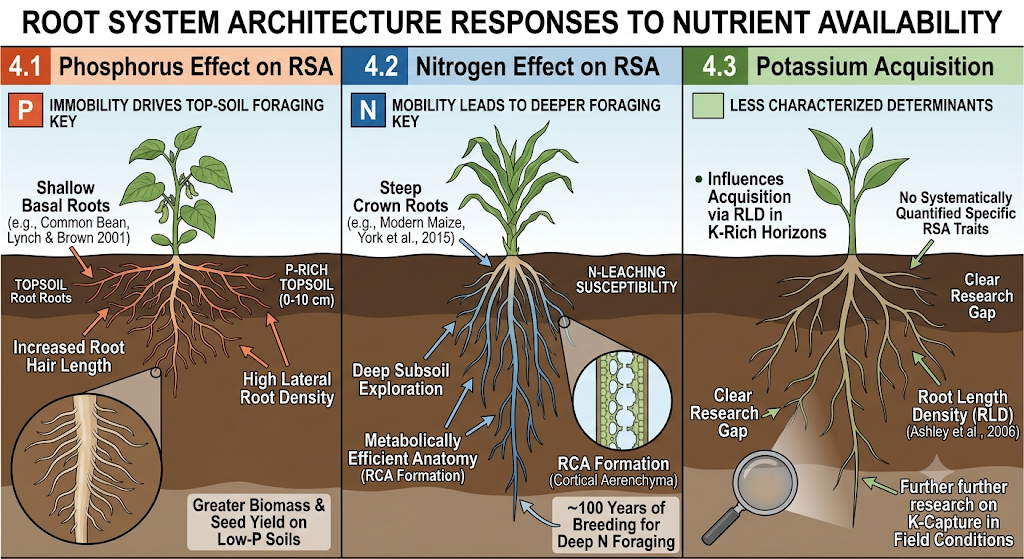 Molecular and architectural determinants of K use efficiency are substantially less characterized than those for N and P. Root architecture influences K acquisition primarily through RLD in K-rich soil horizons, but the specific RSA traits most important for K capture in field conditions have not been systematically quantified. This represents a clear research gap. (Ashley et al.2006)
Figure 2: RSA Response to Nutrient Availability
Table 2.
Selected experimental studies linking RSA traits to nutrient use efficiency outcomes.
| Trait | Crop | Nutrient | Measured Outcome | Experimental Conditions | Citation |
|---|---|---|---|---|---|
| Root hair length | Wheat, barley | P | Longer root hairs associated with higher P acquisition per unit root length | Controlled P-deficient conditions | Gahoonia & Nielsen (1997) |
| Shallow basal root angle | Common bean | P | Greater biomass and seed yield on low-P soils | Field, West Africa; low-P and high-P treatments | Lynch & Brown (2001) |
| Root hair length × soil water | Barley | P | Root hair effects amplified in drying soils | Pot experiment; P × water factorial | Brown et al. (2011) |
| Root cortical aerenchyma | Maize | N, P | Reduced metabolic cost enables greater root exploration | Simulation modelling + experimental validation | Postma & Lynch (2011) |
| Steep crown root angle + low cortical cost | Maize | N | Proposed synergistic effect for subsoil N capture (SCD ideotype) | Theoretical + empirical data synthesis | Lynch (2013) |
| Crown root angle + anatomy evolution | Maize | N | Steeper angles and greater RCA in modern vs historical inbreed | Historical inbred line comparison (~1900–2000) | York et al. (2015) |
5. Crop-Specific Evidence
5.1 Wheat (Triticum aestivum L.)
Wasson et al. (2012) identified narrow root angle distributions concentrating root length vertically, greater maximum root depth, and sufficient deep-layer RLD as key traits for subsoil water capture under terminal drought, with simulation analyses suggesting these combined architectural traits maintain greater grain number under water-limited conditions.
5.2 Rice (Oryza sativa L.)
Uga et al. (2013) cloned DRO1, an auxin-responsive gene controlling gravitropic root curvature, with NILs carrying the deep-rooting allele showing greater RLD at 30–60 cm depth and significantly higher grain yield under severe field drought.
5.3 Maize (Zea mays L.)
Lynch (2013) proposed the Steep, Cheap, and Deep (SCD) ideotype — steep crown root angles combined with metabolically economical root anatomy including constitutive RCA — enabling deep subsoil exploration for leached NO₃⁻ and water recovery, retrospectively validated by York et al. (2015).
5.4 Soybean (Glycine max L.)
Manavalan et al. (2009) identified deeper root biomass distribution as a consistent correlate of drought tolerance, though no formalized RSA ideotype exists and field validation remains limited, with an additional trade-off between root construction costs and symbiotic nitrogen fixation activity.
5.5 Chickpea (Cicer arietinum L.)
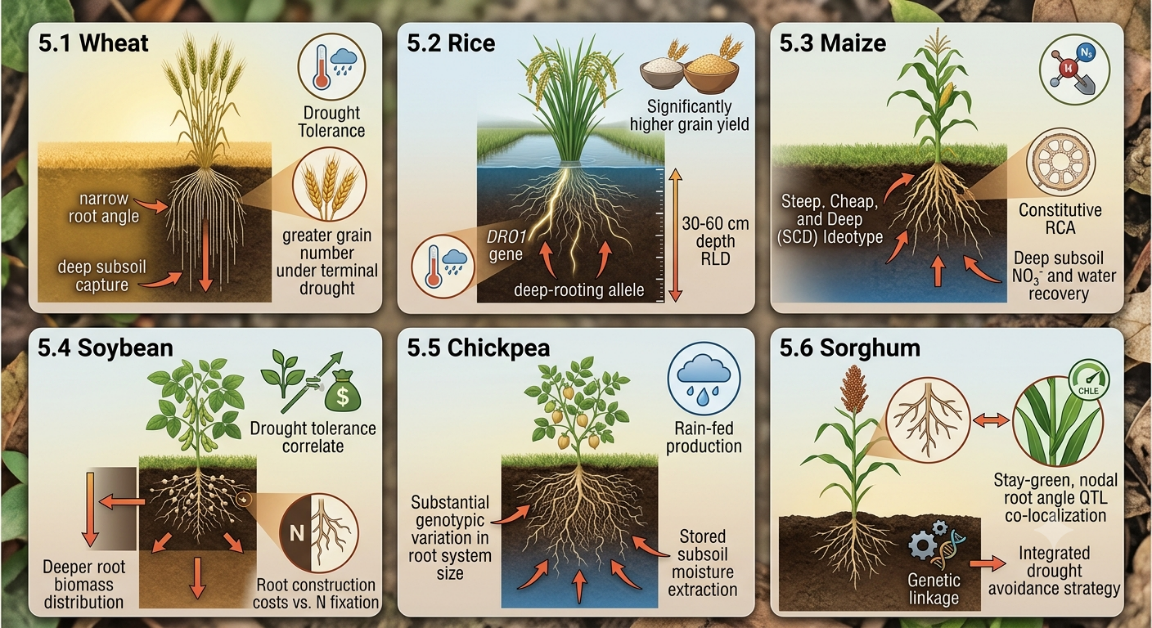 Figure 3: Crop-Specific Evidence
Kashiwagi et al. (2005) demonstrated substantial genotypic variation in root system size within a mini-core collection, with deeper-rooting accessions showing greater capacity for stored subsoil moisture extraction — the primary drought avoidance strategy in South Asian and sub-Saharan rain-fed production systems.
5.6 Sorghum (Sorghum bicolor L. Moench)
Mace et al. (2012) identified nodal root angle QTL co-localising with stay-green and leaf chlorophyll retention QTL, suggesting pleiotropic or tightly linked genetic control of an integrated above- and below-ground drought avoidance strategy in adapted sorghum germplasm.
6. Root Phenotyping Technologies
6.1 Minirhizotrons
Minirhizotrons are transparent access tubes installed in soil at defined angles, through which root images are acquired using cameras or endoscopes. This non-destructive technology allows repeated measurement of root growth rate, mortality, and turnover. This information is inaccessible to destructive methods. Bragg et al. (1983) compared minirhizotron designs and established methodological standards still referenced today. Maeght et al. (2013) reviewed methods for studying deep roots and argued that minirhizotrons remain among the most suitable tools for characterizing root dynamics at depth in the field, despite their labor intensity and the artefacts potentially introduced by tube installation.
6.2 Shovelomics
Trachsel et al. (2011) developed shovelomics for field-scale phenotyping of maize crown root architecture. The protocol involves excavating the crown root system at the soil surface, photographing the excavated crown, and scoring architectural traits including crown root number, angle, and lateral branching density. Shovelomics enables phenotyping of large populations at modest cost. This has been deployed across numerous maize diversity panels and breeding populations. Its key limitation is that it captures only the crown root system, providing no information on deep root distribution.
6.3 X-ray Computed Tomography
X-ray CT provides three-dimensional, non-destructive imaging of intact root systems at sub-millimeter resolution. Tracy et al. (2010) demonstrated that X-ray CT could visualize intact root systems in soil at sufficient resolution to measure root diameter and branching topology. Mooney et al. (2012) reviewed X-ray CT development for 3D root system imaging in soil, noting that spatial resolution, sample size, and image reconstruction algorithms were key technical parameters limiting the output.
6.4 Magnetic Resonance Imaging
Magnetic Resonance Imaging (MRI) provides non-invasive 3D imaging without the use of ionizing radiation. Jahnke et al. (2009) demonstrated combined MRI–PET imaging of plant structures and transport dynamics, illustrating the potential to simultaneously characterize root architecture and water distribution. The method is limited by very high instrument cost, long acquisition times, and significant signal attenuation by paramagnetic soil minerals in field-realistic soils.
6.5 Ground-Penetrating Radar
Ground Penetrating Radar (GPR) detects large roots (typically >1 cm diameter) through electromagnetic pulse reflection from objects with contrasting dielectric properties. Its application to annual crop roots (diameter typically 0.1–2 mm) is severely limited by resolution and signal-to-noise constraints. GPR finds application principally in perennial systems where coarse root detection is the objective. Maeght et al. (2013) noted this limitation and emphasized the need for improved sub-resolution techniques for fine-root field detection at depth.
6.6 Root Scanning and WinRHIZO
Root washing followed by flat-bed scanning and WinRHIZO analysis (Arsenault et al., 1995) is the most widely used approach for quantifying RLD, specific root length, and root morphology from soil cores or excavated systems. WinRHIZO provides robust measurements of total root length, diameter distributions, and tip counts, but requires destructive sampling, provides no positional information, and performs less reliably on contaminated or degraded root samples.
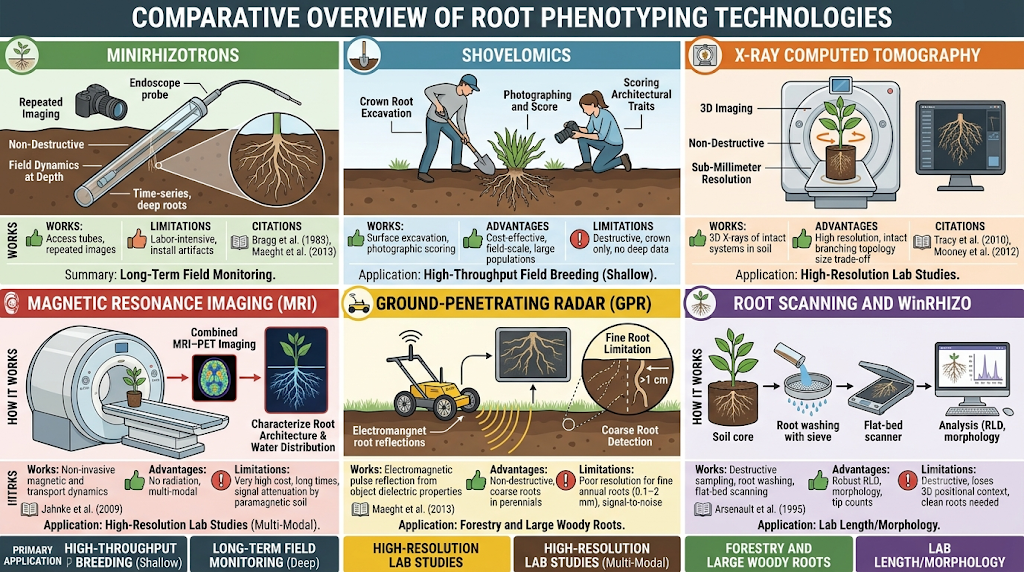 Figure 4: Comparative Overview of Root Phenotyping Technologies
Table 3.
Comparison of root phenotyping technologies for RSA characterisation.
| Technology | Principle | Resolution | Key Advantages | Major Limitations | Reference |
|---|---|---|---|---|---|
| Minirhizotron | Camera through transparent tube | ~0.1 mm | Non-destructive; temporal dynamics; field-applicable | Labour-intensive; small sample volume; tube artefacts | Bragg et al. (1983) |
| WinRHIZO scanning | Digital image analysis of washed roots | ~0.1 mm | Validated; low cost; widely used | Destructive; no spatial context; debris-sensitive | Arsenault et al. (1995) |
| MRI | Nuclear magnetic resonance | ~0.3–1 mm | Non-ionising; simultaneous water imaging | Very high cost; long acquisition; soil mineral interference | Jahnke et al. (2009) |
| Shovelomics | Destructive excavation+ photography | Crown traits | Field-applicable; low cost; large populations | Crown-only; no subsoil data | Trachsel et al. (2011) |
| X-ray CT | 3D X-ray attenuation imaging | <0.1 mm | 3D; non-destructive; high resolution | Cost; small sample size; ionising radiation | Mooney et al. (2012) |
| GPR | Electromagnetic reflection | ~cm | Large-scale field survey | Limited to coarse roots; poor performance in annual crops | Maeght et al. (2013) |
7. Artificial Intelligence and Digital Agriculture in Root Phenotyping
7.1 SmartRoot
Lobet et al. (2011) developed SmartRoot as an ImageJ plugin for semi-automated quantitative analysis of root system architecture from 2D images. The software traces individual root axes and quantifies root length, branching topology, root angles, and inter-lateral distances. Lobet et al. (2011) validated SmartRoot against manual measurements for multiple RSA parameters, demonstrating high concordance. The semi-automated workflow requires user-guided tracing, limiting throughput for very large populations.
7.2 WinRHIZO
WinRHIZO uses color threshold algorithms on flat-bed scanner images of washed roots to generate total root length, projected area, volume, and tip count. It remains one of the most widely adopted platforms in root morphology research despite its limitations for architectural analysis. (Arsenault et al., 1995)
7.3 RootNav
Pound et al. (2013) developed RootNav for semi-automated measurement of root architecture from 2D images of seedlings grown on agar or filter paper, using A*-based path-following algorithms to trace root architecture graphs. RootNav provides accurate measurements of primary root length, lateral root number, and emergence angle for simple root systems, and was validated against manual measurements across several root architecture parameters. Its application is primarily limited to seedling-stage roots in controlled media.
7.4 DIRT (Digital Imaging of Root Traits)
DIRT web platform for extracting root morphological and architectural traits from 2D images, extending the computational framework used in shovelomics Das et al. (2015). Bucksch et al. (2014) applied digital analysis tools to shovelomics images in a field study of maize crown roots, demonstrating that digitally extracted architectural traits showed significant genetic variation and correlation with nitrogen stress performance in field trials, providing field-scale validation of the digital phenotyping approach.
7.5 GLO-Roots and Soil-Based Imaging
Rellán-Álvarez et al. (2015) developed the GLO-Roots platform using custom rhizotrons with transparent soil-like media and luciferase-expressing transgenic reporter lines, enabling multidimensional characterization of root architecture and gene expression simultaneously. While limited in applicability to field crops in its current form, this system enables precise characterization of root developmental responses to nutrient and water gradients with spatial resolution unavailable in soil.
7.6 Deep Learning Approaches
Convolutional neural networks and U-Net segmentation architectures have been applied to the challenging problem of separating root voxels from soil backgrounds in X-ray CT image stacks. Smith et al. (2020) applied U-Net–based deep learning to segment maize roots from soil in X-ray microCT images and achieved substantially superior segmentation accuracy compared to classical threshold approaches, with improvements in resolving fine lateral roots adjacent to the soil matrix. The primary limitation of deep learning approaches is the requirement for large, expertly annotated training datasets. Iyer-Pascuzzi et al. (2010) described earlier automated phenotyping platforms for root architecture in transparent media that paved the way for current deep learning approaches.
Table 4.
Comparison of AI and digital root phenotyping platforms.
| Platform | Principle | Application | Key Performance Metric | Key Limitation | Reference |
|---|---|---|---|---|---|
| WinRHIZO | Colour threshold scan analysis | Washed root morphology | Validated for length and diameter | No topology; performance degrades with debris | Arsenault et al. (1995) |
| SmartRoot | Semi-automated ImageJ plugin | 2D images (seedling to field crown) | High accuracy vs. manual measurement | Semi-automated; labour-intensive for large populations | Lobet et al. (2011) |
| RootNav | A\*-path graph tracing | 2D agar/filter paper seedlings | High accuracy for simple systems | Limited to controlled-media seedling roots | Pound et al. (2013) |
| DIRT | Web-based image processing | Shovelomics crown images | Field-validated; high throughput | Crown root only; no subsoil information | Das et al. (2015) |
| GLO-Roots | Luminescence + custom rhizotron | Soil-like media; reporter lines | Simultaneous architecture + gene expression | Requires transgenic lines; not field-deployable | Rellán-Álvarez et al. (2015) |
| U-Net deep learning | CNN segmentation | X-ray CT soil root stacks | Superior to threshold segmentation of fine roots | Requires large annotated training dataset | Smith et al. (2020) |
8. Genetics and Breeding for RSA Improvement
8.1 Key RSA Genes
DRO1 remains the best characterized and agronomically validated RSA gene, encoding an auxin-responsive protein controlling asymmetric cortical cell elongation during gravitropism, with deep-rooting NILs maintaining higher yield under field drought (Uga et al., 2013). Orthologues identified across multiple species suggest conserved gravitropic regulatory mechanism. LBD transcription factors regulate lateral root initiation in maize and grasses, with variation in expression associated with lateral root density, though field validation remains limited (Hochholdinger et al., 2004). Root hair traits controlling P acquisition are heritable and genetically mappable in barley (George et al., 2014), with root hair length QTL identified on chromosomes 2, 3, 5, and 7 in maize under P deficiency (Zhu et al., 2005).
8.2 QTL Studies
QTL mapping confirms RSA traits are polygenic with continuous variation across all major crops. The major QTL identified on five chromosomes in wheat explaining up to 17% of seminal root length variance (Ren et al., 2012), 16 consensus meta-QTL in rice (Courtois et al., 2009), nodal root angle QTL co-localizing with drought adaptation QTL in sorghum (Mace et al., 2012), and multiple seedling root trait loci in maize (Pace et al., 2015) — collectively favoring quantitative selection over single-gene approaches.
8.3 Genome-Wide Association Studies
GWAS reveals a highly polygenic architecture for most RSA traits, with individual SNP associations explaining 3–8% of phenotypic variance in maize (Pace et al., 2015) and rice (Topp et al., 2013). Careful control of population structure is essential given potential confounding with environmental differentiation gradients.
8.4 Genomic Selection
The polygenic architecture of RSA traits makes genomic selection (GS) an attractive strategy for accelerating genetic gain, with prediction accuracy highest when training populations are phenotype in the target environment. This is a critical given strong G×E interaction in RSA traits (Voss-Fels et al., 2019). Integration of RSA phenotypic data with genomic information for agronomic performance prediction remains a promising but underemployed framework.
8.5 CRISPR Applications
CRISPR-Cas9 enables precise modification of RSA regulatory loci, though characterization of causal allelic variants is a prerequisite for effective editing (Scheben et al., 2016). DRO1 in rice conceptually supports CRISPR-based introgression, though validation across additional genetic backgrounds and environments remains necessary.
Table 5.
Selected genes and QTLs controlling RSA traits in major crops.
| Gene / QTL | Species | Trait | Reported Effect | Citation |
|---|---|---|---|---|
| Basal root gravitropism QTL (LG B2, B9) | Common bean | Basal root angle | Shallower angle increases P acquisition in low-P soils | Liao et al. (2004) |
| Qtl12.1 drought resistance | Rice | Water uptake from deeper layers | Large-effect drought QTL; mechanism through roots | Bernier et al. (2009) |
| 16 meta-QTL for root architecture | Rice | Root length, thickness, mass in soil | Consensus regions across multiple populations | Courtois et al. (2009) |
| *qDRO1* (mapping QTL) | Rice | Root angle, maximum root depth | Large-effect QTL; map-based cloning source | Uga et al. (2011) |
| Seminal root QTL (chr 1A, 2B, 3B, 4A, 5A) | Wheat | Seminal root length and morphology | Individual QTL up to 17% PVE | Ren et al. (2012) |
| Nodal root angle QTL | Sorghum | Nodal root angle | Co-localised with drought adaptation QTL | Mace et al. (2012) |
| *DRO1* | Rice | Root gravitropic angle | Steeper root growth; improved drought yield in NILs | Uga et al. (2013) |
| Seedling RSA GWAS loci | Maize | Multiple root developmental traits | Individual SNP effects 3–8% PVE | Pace et al. (2015) |
9. Knowledge Gaps and Limitations
The most critical phenotyping difficulty remains the absence of high-throughput field methods for characterizing root distribution below 30–40 cm. This leaves deep roots which are the most agronomically relevant architectural dimension unassessed and hence least characterized (Atkinson et al., 2019; Maeght et al., 2013). A substantial proportion of mechanistic RSA evidence derives from controlled environments, with translation to field performance frequently assumed but inconsistently validated (Wasson et al., 2012). Compounding this, RSA traits show strong G×E interactions, with deep rooting advantages critically dependent on subsoil water availability across soil types and seasons, making multi-environment phenotyping essential for broad adaptation breeding.
Rhizosphere biology remains largely absent from current RSA-improvement frameworks. The arbuscular mycorrhizal fungi extend effective P depletion zones well beyond root length–based model predictions, and their interactions with host root architecture represent a significant mechanistic gap (Philippot et al., 2013). Mechanistic RSA research remains heavily concentrated in maize, rice, wheat, and common bean, with substantially thinner evidence for sorghum, pearl millet, cassava, cowpea, and other staples critical to food-insecure regions.
At the data level, the absence of standardized root trait ontologies, open repositories, and reproducible image analysis pipelines limits cross-study comparability and meta-analytic synthesis (Lobet, 2017). Looking forward, quantitative projections of RSA ideotype value under future climate scenarios such as altered drought frequency, soil water distribution, and N mineralization dynamics, are currently absent from the literature, representing a gap addressable through integration of RSA modelling with regional climate projections (IPCC, 2021).
10. Future Research Directions
Priority needs include scalable deep-field root phenotyping below 30 cm, multi-omics integration under combined stresses, and extension of mechanistic models to incorporate rhizosphere processes including mycorrhizal symbiosis. Climate-ready RSA ideotypes should be identified through simulation studies integrating regional climate projections. Standardized open phonemics databases and accelerated translation of root traits into commercially released varieties like the DRO1 gene in rice that remains critical to unmet needs.
11. Conclusions
RSA is a well-established but underexploited determinant of WUE and NUE. A deep, steep root systems access subsoil water and N; shallow, high-surface-area systems with long root hairs capture immobile P; and anatomically efficient roots with reduced cortical cell files and constitutive aerenchyma extend soil exploration per unit carbon investment. These principles are supported by experimental evidence across multiple species and environments, with heritable loci identified through genetic dissection, most notably DRO1 in rice.
Despite this mechanistic foundation, the gap between understanding and practical crop improvement remains substantial. Field validation is often environment specific. Subsoil phenotyping methodologies are technically unsolved. The rhizosphere biology is incompletely integrated into RSA models. The commercially released varieties with demonstrably improved root architecture remain very few. Substantially increased investment in root science ranging from field phenotyping technology to breeding infrastructure and placement of root architecture alongside yield and disease resistance as a primary breeding criterion represents the most promising path to practical improvement in crop resource use efficiency.
Reference
Ashley, M. K., Grant, M., & Grabov, A. (2005). Plant responses to potassium deficiencies: a role for potassium transport proteins. Journal of Experimental Botany, 57(2), 425–436. https://doi.org/10.1093/jxb/erj034
Bengough, A. G., McKenzie, B. M., Hallett, P. D., & Valentine, T. A. (2010). Root elongation, water stress, and mechanical impedance: a review of limiting stresses and beneficial root tip traits. Journal of Experimental Botany, 62(1), 59–68. https://doi.org/10.1093/jxb/erq350
Bernier, J., Serraj, R., Kumar, A., Venuprasad, R., Impa, S., RP, V. G., Oane, R., Spaner, D., & Atlin, G. (2008). The large-effect drought-resistance QTL qtl12.1 increases water uptake in upland rice. Field Crops Research, 110(2), 139–146. https://doi.org/10.1016/j.fcr.2008.07.010
Bishopp, A., & Lynch, J. P. (2015). The hidden half of crop yields. Nature Plants, 1(8), 15117. https://doi.org/10.1038/nplants.2015.117
Bucksch, A., Burridge, J., York, L. M., Das, A., Nord, E., Weitz, J. S., & Lynch, J. P. (2014). Image-Based High-Throughput Field phenotyping of crop roots. PLANT PHYSIOLOGY, 166(2), 470–486. https://doi.org/10.1104/pp.114.243519
Chimungu, J. G., Brown, K. M., & Lynch, J. P. (2014). Reduced root cortical cell file number improves drought tolerance in maize. PLANT PHYSIOLOGY, 166(4), 1943–1955. https://doi.org/10.1104/pp.114.249037
Comas, L. H., Becker, S. R., Cruz, V. M. V., Byrne, P. F., & Dierig, D. A. (2013). Root traits contributing to plant productivity under drought. Frontiers in Plant Science, 4, 442. https://doi.org/10.3389/fpls.2013.00442
Courtois, B., Ahmadi, N., Khowaja, F., Price, A. H., Rami, J., Frouin, J., Hamelin, C., & Ruiz, M. (2009). Rice Root Genetic Architecture: Meta-analysis from a Drought QTL Database. Rice, 2(2–3), 115–128. https://doi.org/10.1007/s12284-009-9028-9
Das, A., Schneider, H., Burridge, J., Ascanio, A. K. M., Wojciechowski, T., Topp, C. N., Lynch, J. P., Weitz, J. S., & Bucksch, A. (2015). Digital imaging of root traits (DIRT): a high-throughput computing and collaboration platform for field-based root phenomics. Plant Methods, 11(1), 51. https://doi.org/10.1186/s13007-015-0093-3
Fitter, A. H., Stickland, T. R., Harvey, M. L., & Wilson, G. W. (1991). Architectural analysis of plant root systems 1. Architectural correlates of exploitation efficiency. New Phytologist, 118(3), 375–382. https://doi.org/10.1111/j.1469-8137.1991.tb00018.x
Gallais, A., & Hirel, B. (2004). An approach to the genetics of nitrogen use efficiency in maize. Journal of Experimental Botany, 55(396), 295–306. https://doi.org/10.1093/jxb/erh006
George, T. S., Brown, L. K., Ramsay, L., White, P. J., Newton, A. C., Bengough, A. G., Russell, J., & Thomas, W. T. B. (2014). Understanding the genetic control and physiological traits associated with rhizosheath production by barley (Hordeum vulgare). New Phytologist, 203(1), 195–205. https://doi.org/10.1111/nph.12786
Godfray, H. C. J., Beddington, J. R., Crute, I. R., Haddad, L., Lawrence, D., Muir, J. F., Pretty, J., Robinson, S., Thomas, S. M., & Toulmin, C. (2010). Food security: the challenge of feeding 9 billion people. Science, 327(5967), 812–818. https://doi.org/10.1126/science.1185383
Good, A. G., Shrawat, A. K., & Muench, D. G. (2004). Can less yield more? Is reducing nutrient input into the environment compatible with maintaining crop production? Trends in Plant Science, 9(12), 597–605. https://doi.org/10.1016/j.tplants.2004.10.008
Hammer, G. L., Dong, Z., McLean, G., Doherty, A., Messina, C., Schussler, J., Zinselmeier, C., Paszkiewicz, S., & Cooper, M. (2009). Can changes in canopy and/or root system architecture explain historical maize yield trends in the U.S. corn belt? Crop Science, 49(1), 299–312. https://doi.org/10.2135/cropsci2008.03.0152
Hamzah, M., Haines, B. L., & Todd, R. L. (1983). A technique for estimating fine root production in the forest ecosystems. Plant and Soil, 73(3), 421–423. https://doi.org/10.1007/bf02184319
Henry, A., Cal, A. J., Batoto, T. C., Torres, R. O., & Serraj, R. (2012). Root attributes affecting water uptake of rice (Oryza sativa) under drought. Journal of Experimental Botany, 63(13), 4751–4763. https://doi.org/10.1093/jxb/ers150
Herder, G. D., Van Isterdael, G., Beeckman, T., & De Smet, I. (2010). The roots of a new green revolution. Trends in Plant Science, 15(11), 600–607. https://doi.org/10.1016/j.tplants.2010.08.009
Ho, M. D., Rosas, J. C., Brown, K. M., & Lynch, J. P. (2005). Root architectural tradeoffs for water and phosphorus acquisition. Functional Plant Biology, 32(8), 737–748. https://doi.org/10.1071/fp05043
Hochholdinger, F., Park, W. J., Sauer, M., & Woll, K. (2003). From weeds to crops: genetic analysis of root development in cereals. Trends in Plant Science, 9(1), 42–48. https://doi.org/10.1016/j.tplants.2003.11.003
Hochholdinger, F., & Tuberosa, R. (2009). Genetic and genomic dissection of maize root development and architecture. Current Opinion in Plant Biology, 12(2), 172–177. https://doi.org/10.1016/j.pbi.2008.12.002
Iyer-Pascuzzi, A. S., Symonova, O., Mileyko, Y., Hao, Y., Belcher, H., Harer, J., Weitz, J. S., & Benfey, P. N. (2010). Imaging and analysis platform for automatic phenotyping and trait ranking of plant root systems. PLANT PHYSIOLOGY, 152(3), 1148–1157. https://doi.org/10.1104/pp.109.150748
Jahnke, S., Menzel, M. I., Van Dusschoten, D., Roeb, G. W., Bühler, J., Minwuyelet, S., Blümler, P., Temperton, V. M., Hombach, T., Streun, M., Beer, S., Khodaverdi, M., Ziemons, K., Coenen, H. H., & Schurr, U. (2009). Combined MRI–PET dissects dynamic changes in plant structures and functions. The Plant Journal, 59(4), 634–644. https://doi.org/10.1111/j.1365-313x.2009.03888.x
Kashiwagi, J., Krishnamurthy, L., Upadhyaya, H. D., Krishna, H., Chandra, S., Vadez, V., & Serraj, R. (2005). Genetic variability of drought-avoidance root traits in the mini-core germplasm collection of chickpea (Cicer arietinum L.). Euphytica, 146(3), 213–222. https://doi.org/10.1007/s10681-005-9007-1
Kell, D. B. (2011). Breeding crop plants with deep roots: their role in sustainable carbon, nutrient and water sequestration. Annals of Botany, 108(3), 407–418. https://doi.org/10.1093/aob/mcr175
Lambers, H., Shane, M. W., Cramer, M. D., Pearse, S. J., & Veneklaas, E. J. (2006). Root structure and functioning for efficient acquisition of phosphorus: matching morphological and physiological traits. Annals of Botany, 98(4), 693–713. https://doi.org/10.1093/aob/mcl114
Liao, H., Yan, X., Rubio, G., Beebe, S. E., Blair, M. W., & Lynch, J. P. (2004). Genetic mapping of basal root gravitropism and phosphorus acquisition efficiency in common bean. Functional Plant Biology, 31(10), 959–970. https://doi.org/10.1071/fp03255
Lobet, G. (2017). Image analysis in Plant Sciences: Publish then Perish. Trends in Plant Science, 22(7), 559–566. https://doi.org/10.1016/j.tplants.2017.05.002
Lobet, G., Couvreur, V., Meunier, F., Javaux, M., & Draye, X. (2014). Plant water uptake in drying soils. PLANT PHYSIOLOGY, 164(4), 1619–1627. https://doi.org/10.1104/pp.113.233486
Lobet, G., Pagès, L., & Draye, X. (2011). A novel Image-Analysis toolbox enabling quantitative analysis of root system architecture. PLANT PHYSIOLOGY, 157(1), 29–39. https://doi.org/10.1104/pp.111.179895
Lynch, J. P. (2007). Roots of the second green Revolution. Australian Journal of Botany, 55(5), 493–512. https://doi.org/10.1071/bt06118
Lynch, J. P. (2013). Steep, cheap and deep: an ideotype to optimize water and N acquisition by maize root systems. Annals of Botany, 112(2), 347–357. https://doi.org/10.1093/aob/mcs293
Lynch, J. P. (2019). Root phenotypes for improved nutrient capture: an underexploited opportunity for global agriculture. New Phytologist, 223(2), 548–564. https://doi.org/10.1111/nph.15738
Lynch, J. P., & Brown, K. M. (2001). Topsoil foraging – an architectural adaptation of plants to low phosphorus availability. Plant and Soil, 237(2), 225–237. https://doi.org/10.1023/a:1013324727040
Mace, E. S., Singh, V., Van Oosterom, E. J., Hammer, G. L., Hunt, C. H., & Jordan, D. R. (2011). QTL for nodal root angle in sorghum (Sorghum bicolor L. Moench) co-locate with QTL for traits associated with drought adaptation. Theoretical and Applied Genetics, 124(1), 97–109. https://doi.org/10.1007/s00122-011-1690-9
Maeght, J., Rewald, B., & Pierret, A. (2013). How to study deep roots—and why it matters. Frontiers in Plant Science, 4, 299. https://doi.org/10.3389/fpls.2013.00299
Mairhofer, S., Zappala, S., Tracy, S. R., Sturrock, C., Bennett, M., Mooney, S. J., & Pridmore, T. (2011). RooTrak: Automated Recovery of Three-Dimensional Plant Root Architecture in Soil from X-Ray Microcomputed Tomography Images Using Visual Tracking. PLANT PHYSIOLOGY, 158(2), 561–569. https://doi.org/10.1104/pp.111.186221
Manavalan, L. P., Guttikonda, S. K., Tran, L. P., & Nguyen, H. T. (2009). Physiological and molecular approaches to improve drought resistance in soybean. Plant and Cell Physiology, 50(7), 1260–1276. https://doi.org/10.1093/pcp/pcp082
Manschadi, A. M., Christopher, J., deVoil, P., & Hammer, G. L. (2006). The role of root architectural traits in adaptation of wheat to water-limited environments. Functional Plant Biology, 33(9), 823–837. https://doi.org/10.1071/fp06055
Mooney, S. J., Pridmore, T. P., Helliwell, J., & Bennett, M. J. (2011). Developing X-ray Computed Tomography to non-invasively image 3-D root systems architecture in soil. Plant and Soil, 352(1–2), 1–22. https://doi.org/10.1007/s11104-011-1039-9
Nibau, C., Gibbs, D. J., & Coates, J. C. (2008). Branching out in new directions: the control of root architecture by lateral root formation. New Phytologist, 179(3), 595–614. https://doi.org/10.1111/j.1469-8137.2008.02472.x
Philippot, L., Raaijmakers, J. M., Lemanceau, P., & Van Der Putten, W. H. (2013). Going back to the roots: the microbial ecology of the rhizosphere. Nature Reviews Microbiology, 11(11), 789–799. https://doi.org/10.1038/nrmicro3109
Postma, J. A., Dathe, A., & Lynch, J. P. (2014). The optimal lateral root branching density for maize depends on nitrogen and phosphorus availability. PLANT PHYSIOLOGY, 166(2), 590–602. https://doi.org/10.1104/pp.113.233916
Postma, J. A., & Lynch, J. P. (2010). Theoretical evidence for the functional benefit of root cortical aerenchyma in soils with low phosphorus availability. Annals of Botany, 107(5), 829–841. https://doi.org/10.1093/aob/mcq199
Pound, M. P., French, A. P., Atkinson, J. A., Wells, D. M., Bennett, M. J., & Pridmore, T. (2013). RootNav: Navigating images of complex root architectures. PLANT PHYSIOLOGY, 162(4), 1802–1814. https://doi.org/10.1104/pp.113.221531
Price, A., Steele, K., Gorham, J., Bridges, J., Moore, B., Evans, J., Richardson, P., & Jones, R. (2002). Upland rice grown in soil-filled chambers and exposed to contrasting water-deficit regimes. Field Crops Research, 76(1), 11–24. https://doi.org/10.1016/s0378-4290(02)00012-6
Rellán-Álvarez, R., Lobet, G., Lindner, H., Pradier, P., Sebastian, J., Yee, M., Geng, Y., Trontin, C., LaRue, T., Schrager-Lavelle, A., Haney, C. H., Nieu, R., Maloof, J., Vogel, J. P., & Dinneny, J. R. (2015). GLO-Roots: an imaging platform enabling multidimensional characterization of soil-grown root systems. eLife, 4. https://doi.org/10.7554/elife.07597
Ren, Y., He, X., Liu, D., Li, J., Zhao, X., Li, B., Tong, Y., Zhang, A., & Li, Z. (2011). Major quantitative trait loci for seminal root morphology of wheat seedlings. Molecular Breeding, 30(1), 139–148. https://doi.org/10.1007/s11032-011-9605-7
Rockström, J., Steffen, W., Noone, K., Persson, Å., Chapin, F. S., Lambin, E. F., Lenton, T. M., Scheffer, M., Folke, C., Schellnhuber, H. J., Nykvist, B., De Wit, C. A., Hughes, T., Van Der Leeuw, S., Rodhe, H., Sörlin, S., Snyder, P. K., Costanza, R., Svedin, U., . . . Foley, J. A. (2009). A safe operating space for humanity. Nature, 461(7263), 472–475. https://doi.org/10.1038/461472a
Saengwilai, P., Tian, X., & Lynch, J. P. (2014). Low Crown Root Number Enhances Nitrogen Acquisition from Low-Nitrogen Soils in Maize. PLANT PHYSIOLOGY, 166(2), 581–589. https://doi.org/10.1104/pp.113.232603
Smith, A. G., Petersen, J., Selvan, R., & Rasmussen, C. R. (2020). Segmentation of roots in soil with U-Net. Plant Methods, 16(1), 13. https://doi.org/10.1186/s13007-020-0563-0
Steudle, E., & Peterson, C. A. (1998). How does water get through roots? Journal of Experimental Botany, 49(322), 775–788. https://doi.org/10.1093/jxb/49.322.775
The State of Food and Agriculture 2020. (2020). In FAO eBooks. https://doi.org/10.4060/cb1447en
Tilman, D., Cassman, K. G., Matson, P. A., Naylor, R., & Polasky, S. (2002). Agricultural sustainability and intensive production practices. Nature, 418(6898), 671–677. https://doi.org/10.1038/nature01014
Topp, C. N., Iyer-Pascuzzi, A. S., Anderson, J. T., Lee, C., Zurek, P. R., Symonova, O., Zheng, Y., Bucksch, A., Mileyko, Y., Galkovskyi, T., Moore, B. T., Harer, J., Edelsbrunner, H., Mitchell-Olds, T., Weitz, J. S., & Benfey, P. N. (2013). 3D phenotyping and quantitative trait locus mapping identify core regions of the rice genome controlling root architecture. Proceedings of the National Academy of Sciences, 110(18), E1695-704. https://doi.org/10.1073/pnas.1304354110
Trachsel, S., Kaeppler, S. M., Brown, K. M., & Lynch, J. P. (2010). Shovelomics: high throughput phenotyping of maize (Zea mays L.) root architecture in the field. Plant and Soil, 341(1–2), 75–87. https://doi.org/10.1007/s11104-010-0623-8
Tracy, S. R., Roberts, J. A., Black, C. R., McNeill, A., Davidson, R., & Mooney, S. J. (2010). The X-factor: visualizing undisturbed root architecture in soils using X-ray computed tomography. Journal of Experimental Botany, 61(2), 311–313. https://doi.org/10.1093/jxb/erp386
Uga, Y., Okuno, K., & Yano, M. (2011). Dro1, a major QTL involved in deep rooting of rice under upland field conditions. Journal of Experimental Botany, 62(8), 2485–2494. https://doi.org/10.1093/jxb/erq429
Uga, Y., Sugimoto, K., Ogawa, S., Rane, J., Ishitani, M., Hara, N., Kitomi, Y., Inukai, Y., Ono, K., Kanno, N., Inoue, H., Takehisa, H., Motoyama, R., Nagamura, Y., Wu, J., Matsumoto, T., Takai, T., Okuno, K., & Yano, M. (2013). Control of root system architecture by DEEPER ROOTING 1 increases rice yield under drought conditions. Nature Genetics, 45(9), 1097–1102. https://doi.org/10.1038/ng.2725
Vance, C. P., Uhde‐Stone, C., & Allan, D. L. (2003). Phosphorus acquisition and use: critical adaptations by plants for securing a nonrenewable resource. New Phytologist, 157(3), 423–447. https://doi.org/10.1046/j.1469-8137.2003.00695.x
Varshney, R. K., Song, C., Saxena, R. K., Azam, S., Yu, S., Sharpe, A. G., Cannon, S., Baek, J., Rosen, B. D., Tar’an, B., Millan, T., Zhang, X., Ramsay, L. D., Iwata, A., Wang, Y., Nelson, W., Farmer, A. D., Gaur, P. M., Soderlund, C., . . . Cook, D. R. (2013). Draft genome sequence of chickpea (Cicer arietinum) provides a resource for trait improvement. Nature Biotechnology, 31(3), 240–246. https://doi.org/10.1038/nbt.2491
Voss-Fels, K. P., Cooper, M., & Hayes, B. J. (2018). Accelerating crop genetic gains with genomic selection. Theoretical and Applied Genetics, 132(3), 669–686. https://doi.org/10.1007/s00122-018-3270-8
Wasson, A. P., Richards, R. A., Chatrath, R., Misra, S. C., Prasad, S. V. S., Rebetzke, G. J., Kirkegaard, J. A., Christopher, J., & Watt, M. (2012). Traits and selection strategies to improve root systems and water uptake in water-limited wheat crops. Journal of Experimental Botany, 63(9), 3485–3498. https://doi.org/10.1093/jxb/ers111
York, L. M., Galindo-Castaneda, T., Schussler, J. R., & Lynch, J. P. (2015). Evolution of US maize (Zea mays L.) root architectural and anatomical phenes over the past 100 years corresponds to increased tolerance of nitrogen stress. Journal of Experimental Botany, 66(8), 2347–2358. https://doi.org/10.1093/jxb/erv074
York, L. M., Nord, E. A., & Lynch, J. P. (2013). Integration of root phenes for soil resource acquisition. Frontiers in Plant Science, 4, 355. https://doi.org/10.3389/fpls.2013.00355
Zhu, J., Brown, K. M., & Lynch, J. P. (2009). Root cortical aerenchyma improves the drought tolerance of maize (Zea mays L.). Plant Cell & Environment, 33(5), 740–749. https://doi.org/10.1111/j.1365-3040.2009.02099.x
Zhu, J., Kaeppler, S. M., & Lynch, J. P. (2005). Mapping of QTL controlling root hair length in maize (Zea mays L.) under phosphorus deficiency. Plant and Soil, 270(1), 299–310. https://doi.org/10.1007/s11104-004-1697-y
Zhu, J., & Lynch, J. P. (2004). The contribution of lateral rooting to phosphorus acquisition efficiency in maize (Zea mays) seedlings. Functional Plant Biology, 31(10), 949–958. https://doi.org/10.1071/fp04046
Get an email when we publish new research and open calls for chapters.
Create a free account